
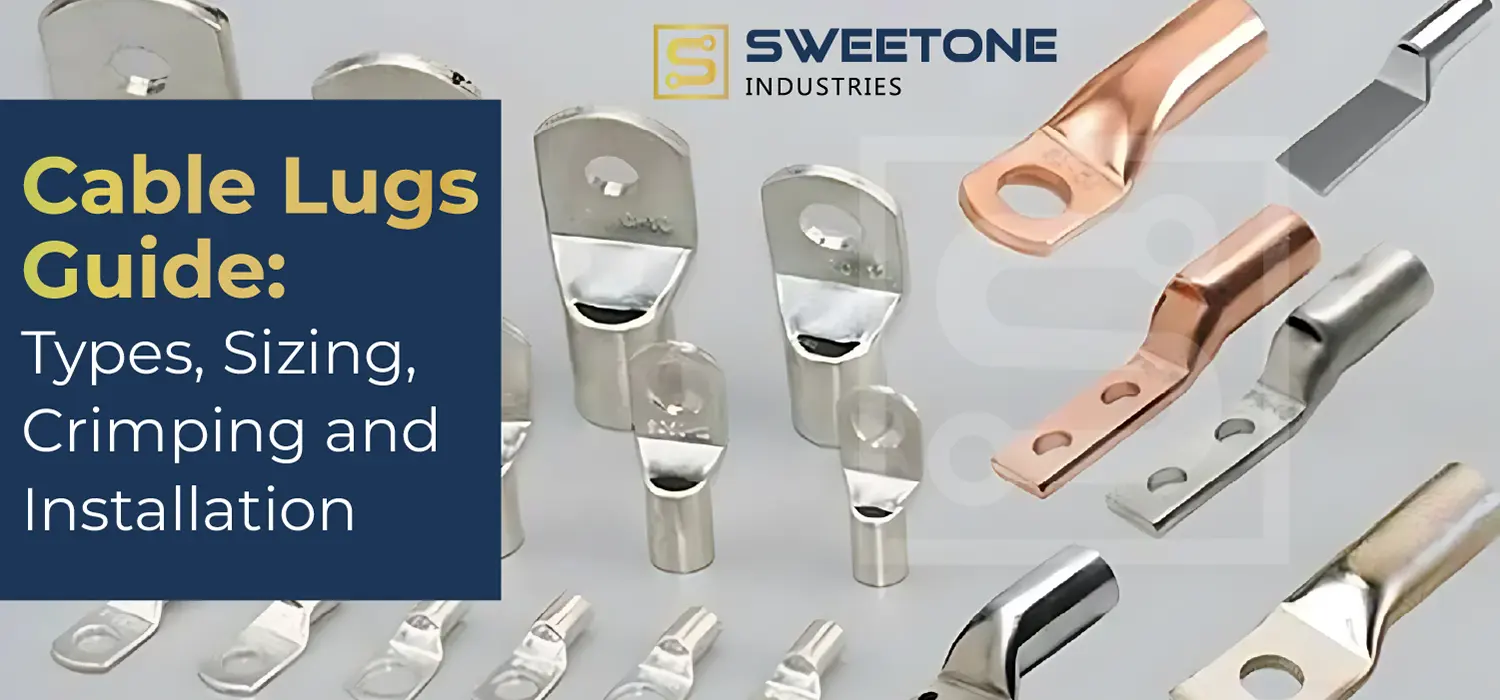
Picture an electrician opening a distribution board and finding a blackened cable end. A loose connection can generate enough heat to damage the terminal. Cable lugs help avoid that problem when someone chooses and fits them correctly. They join cables to breakers, busbars and machinery. But a lug that looks right is not necessarily suitable. Metal, barrel, bolt hole and crimp must match.
Cable Lugs Guide: Types, Sizing, Crimping, and Installation for Everyday Electrical Work
A cable lug has two working parts: a barrel that grips the stripped conductor and a palm that attaches to the equipment. Compression lugs need a crimping tool. Mechanical versions hold the wire with screws instead. Electrical lugs appear in panels, solar installations and motor connections. Poor contact creates heat under heavy current.
Types of Lugs and Where Electricians Use Them
- Copper lugs: Use these with compatible copper cables. Tinned versions resist surface corrosion.
- Aluminium lugs: These connect aluminium conductors, often in power distribution. They need different crimping specifications.
- Bimetallic lugs: These provide an approved aluminium-to-copper transition, such as an aluminium cable ending at a copper busbar.
- Ring terminal lugs: Their closed circular palms sit beneath bolts. The lug stays captured on the stud.
- Fork and pin wire lugs: Fork ends fit permitted screw terminals; pin ends fit suitable terminal blocks. Neither automatically replaces a heavy-duty power lug.
Different types of lugs also come with short barrels, long barrels and inspection windows. Check the product drawing. Similar-looking parts may carry different current ratings on the same equipment.
Choosing Cable Lug Size Without Guesswork
Start with the cable marking. If it says 50mm² copper, select a terminal lug rated for that conductor size and construction. The number describes copper cross-sectional area, not the cable’s outside diameter. Ignore insulation thickness.
Next check the mounting stud. An M8 bolt normally needs an appropriately rated M8 hole, even if the conductor measures 50mm². Check whether the cable uses fine strands, as some standard barrels do not accept flexible conductors properly.
Before buying a lug connector, confirm:
- Conductor material and cross-sectional area
- Solid, stranded or fine-stranded cable construction
- Stud diameter and palm clearance
- Manufacturer’s crimp die and tool requirements
- Moisture, vibration and operating temperature
When selecting lugs electrical installers should also check applicable equipment and project specifications. Do not trim strands to force a large cable into a small barrel.
How to Crimp and Install Cable Lugs
Only a trained person should work on electrical wiring. Isolate the supply, lock it out where required and prove the circuit is dead before touching conductors.
- Prepare the wire. Cut the cable squarely. Strip only the length specified for the lug, without nicking strands.
- Check the barrel. Ensure it is clean, undamaged and approved for the cable material.
- Insert fully. Push the conductor to the end of the barrel. Leave no strands outside.
- Choose the die. Match the crimper, die profile and settings to the exact connector. Aluminium cable lugs may require different dies and manufacturer-approved oxide inhibitor.
- Make each crimp. Follow the supplier’s marked positions, order and number of compressions. A larger barrel does not always mean two crimps.
- Inspect and mount. Look for cracks, misplaced impressions and exposed strands. Fasten the palm against a clean contact surface using the specified bolt torque.
Add approved insulation after inspection where required.
Why Some Lug Connections Overheat
An electrical joint can look tidy and still fail. A wrong die may squeeze the barrel unevenly. A loose bolt may leave too little contact area. Dirt, oxidation and mismatched metals also raise resistance. Never judge a crimp by appearance alone when the manufacturer requires pull testing or other checks. Replace a damaged compression lug instead of trying to squeeze it again. Once crimped and removed, it should not go back into service.
Electrical Components & Assemblies and Manufacturing
The same attention to fit matters beyond cable lugs. Buyers looking for an eyelets manufacturer in India, terminals & connectors or sheet metal & precision components should request
drawings, tolerances and material details. Sweetone Industries works with eyelets, electronic components & assemblies, terminals, connectors and precision metal parts. Check the specific product specification before ordering for an electrical application.
Frequently Asked Questions
1. What lug size fits a 50mm² copper conductor?
Use a compatible 50mm² copper lug, then match its stud hole and conductor class.
2. Which die works for aluminium cable lugs?
Use the connector manufacturer’s specified aluminium-compatible tool and die, not a guessed equivalent.
3. How many crimps are needed?
Follow the lug maker’s chart. Count and positions vary by barrel and tool.
4. How can I inspect a crimped lug?
Check insertion, crimp marks, cracks and strands; perform specified tests where required.
5. Can I reuse a removed cable lug?
Never reuse a previously crimped compression lug. Replace it with a new connector.