
Sheet metal stamping is a commonly utilized manufacturing process for producing metal parts from flat sheets or coils. A stamping press uses a punch and die to force to cut, bend, draw or shape the material into the desired shape. It is a process used by manufacturers for parts that need fixed dimensions, a repeatable shape and smooth production in large quantities.
This process is widely used in the electrical, electronics, automotive, appliance, machinery and industrial manufacturing. Metal stamping can accommodate many part designs, ranging from small contacts and brackets to larger covers and housings. The outcome is dependent upon the metal grade, sheet thickness, die design, press force, and the purpose of the finished component.
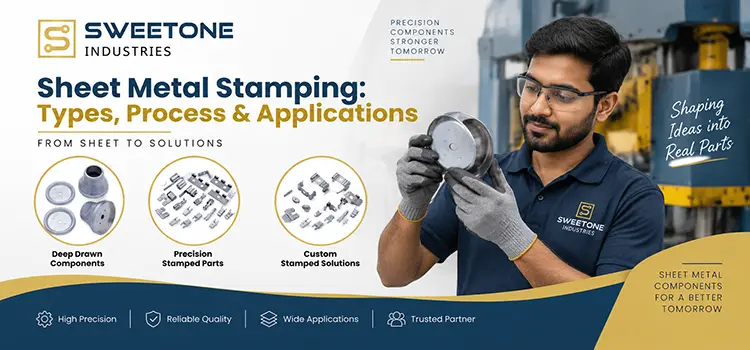
Sheet Metal Stamping: Types, Process & Applications for Precision Components
The working principle is simple. A flat sheet or metal coil enters a press. The die holds the required shape, while the punch applies pressure to the metal. Depending on the job, the sheet may be cut, pierced, bent, drawn, embossed, or shaped during one or more steps.
Some components need a single operation. Others move through several stations before the finished part separates from the strip. This makes stamping useful for simple washers as well as detailed Sheet Metal & Precision Components.
Correct tool design matters because a small change in clearance, bend radius, or punch position can affect the size and fit of the finished part.
Types of Sheet Metal Stamping
Different parts need different stamping methods. The right choice depends on shape, quantity, material, and the number of operations needed.
Progressive Die Stamping
Progressive die stamping uses several workstations inside one die. A metal strip moves from one station to the next while each station performs a separate task.
The first station may punch a hole, another may make a cut, while the next one bends or forms the part. The final station releases the completed component. This method is ideal for high volume production of small precision parts such as components, contacts, clips, brackets and Terminals & Connectors.
Deep Draw Stamping
Deep drawing changes a flat metal blank into a deep or hollow shape. The punch pushes the material into a die cavity while the metal stretches around the tool.
This forming process is used for cups, shells, covers, housings, enclosures and other parts that require more depth than a simple bend. Material selection becomes important in deep drawing because the metal must stretch without tearing, wrinkling, or cracking.
Fourslide Stamping
Fourslide stamping uses several tools that move toward the metal from different sides. It is useful for parts that need several bends, angles, or small details.Clips, springs, electrical contacts, small brackets, and other formed metal parts can be made through this method.
Short-Run Stamping
Short-run stamping suits smaller production quantities. Manufacturers may also use it for sample parts, testing, or jobs where full progressive tooling is not practical.
Separate punching, cutting, bending and forming operations may be employed as indicated by the drawing.
How Does the Metal Stamping Process Work?
Metal stamping starts before the first sheet enters the press. Drawing, material, tooling and production plan shall be checked carefully.
1. Part Drawing and Design
The manufacturer first studies the component drawing. Important details include dimensions, hole positions, bends, material thickness, tolerances, and the final use of the part.
A suitable design helps prevent cracking, distortion, weak edges, and fitting problems.
2. Metal Selection
Different metals behave differently during stamping. Common choices include:
• Mild steel
• Stainless steel
• Copper
• Brass
• Aluminium
• Other metal alloys
Copper and brass are commonly used where electrical conductivity matters, including many Electronic Components & Assemblies. Stainless steel can be useful where strength and corrosion resistance are required.
3. Tool and Die Preparation
The punch and die determine the size and shape of a stamped component. The tooling must match the drawing closely.
If the clearance between punch and die is not correct it can cause rough edges, too many burrs, bad cutting or tool wear. Good tooling also maintains dimensional consistency for a production run.
4. Blanking and Punching
Blanking cuts the outer profile of the part from a larger metal sheet.
Punching removes material to create holes, slots, or openings. These operations are common in sheet metal parts before bending or further shaping.
5. Bending and Forming
Bending changes the angle of the sheet, while metal forming changes its overall shape.
Manufacturers are concerned with hardness, bend radius, thickness and grain direction at this stage. These points help to reduce cracking and undesired deformation.
6. Trimming and Finishing
After stamping, extra metal or sharp edges may need removal. Depending on the product, finishing can include deburring, polishing, plating, cleaning, coating, or heat treatment.
7. Inspection
Finished parts must be checked against the drawing. Manufacturers may inspect dimensions, hole size, bend angle, surface condition, and fitting points.
Inspection becomes especially important for precision metal components used inside larger assemblies.
Common Operations Used in Sheet Metal Stamping
Several operations can be combined to make one stamped part.
Blanking: Cuts the outside shape.
Punching: Makes holes or openings.
Piercing: Removes metal from selected areas.
Bending: Changes the angle of the sheet.
Coining: Uses pressure to create detailed features.
Embossing: Makes raised or recessed patterns.
Flanging: Creates an edge or lip.
Deep drawing: Produces hollow or deep shapes.
The correct combination depends on part design, metal type, and production quantity.
Applications of Sheet Metal Stamping
Sheet metal stamping is used in many industries because a wide range of part sizes and shapes can be produced.
It is used by the Manufacturers of electrical and electronics for Terminals & Connectors. Contacts,clips, brackets, conductive pieces, small housings. These parts usually need tight tolerances to fit properly when assembled.
Automotive manufacturers use stamped parts for clips, brackets, fittings, covers, electrical contacts, and wiring-related components.
The process is also used for Eyelets Manufacturer in India product ranges such as eyelets, small metal fittings, washers, covers, fasteners, machine parts, and other precision pieces.
Why Manufacturers Use Metal Stamping
Metal stamping makes practical sense when the same part needs to be produced many times. Once the tooling is ready, the press can repeat the required operation at a steady rate.
Also, the number of individual manufacturing steps can be reduced, as cutting, punching, bending and forming can be performed in the same die system.
Material choice, tool condition, press settings, dimensional checks as well as the experience of the manufacturer still play a vital role in the quality of the finished part.
FAQs
What is sheet metal stamping?
It is a process that uses a press, punch, and die to cut or shape flat metal into required parts.
Which metals can be stamped?
Steel, stainless steel, aluminium, brass, copper, and several other alloys can be used.
What is metal forming?
Metal forming changes the shape of metal by applying force without removing most of the material.
What is a stamped metal part?
A stamped part is a component made by cutting, bending, punching, or shaping sheet metal in a press.
Where is sheet metal stamping used?
It is used in electrical, automotive, electronics, machinery, appliance, and other industrial sectors.