
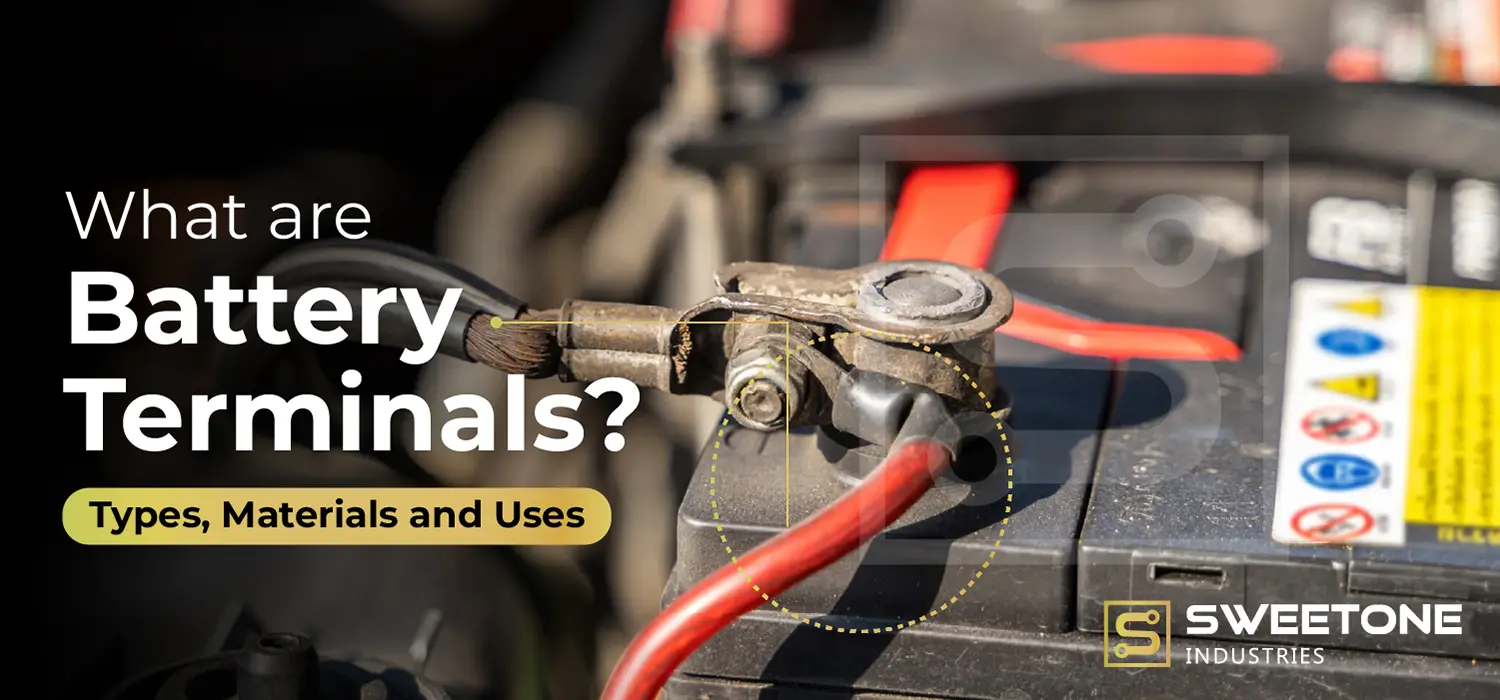
Your car doesn’t start, but there is power in the battery. What is wrong? Sometimes the problem is as easy as a loose or dirty battery terminal. They are metal links that carry electricity from the battery to the starter motor, lights and other electrical parts. And a healthy battery can have a hard time doing its job when the connection gets weak.
The terminals on a battery may come in different shapes, sizes and materials. Some are suitable for cars, others work better on boats, heavy machinery or industrial equipment. Knowing the difference can save you from buying the wrong part.
What Are Battery Terminals? Types, Materials and Uses in Cars and Electrical Equipment
A battery terminal is the metal contact point where a cable connects to a battery. Most automotive batteries have two terminals, marked positive (+) and negative (-). The positive connection carries current into the vehicle’s electrical system, while the negative connection completes the circuit.
A battery connector must fit properly around the post or fastening point. A loose connection can cause poor starting, voltage drops, or excessive heat.
You will find battery terminals in cars, motorcycles, trucks, boats, solar systems, and industrial machines.
Common Battery Terminal Connector Types
Not every battery has the same connection. Here are the battery terminal types you will commonly find.
- Top Post Battery Terminals
Most conventional car batteries have round metal posts on top. A clamp fits around each post and connects it to the battery cable.
These terminals are easy to recognise, inspect, and replace.
- Side Post Battery Terminal
A side post battery terminal sits on the side of the battery rather than the top. Instead of a round clamp, it uses a threaded bolt connection.
Some car manufacturers use this design to save space under the bonnet.
- Marine Battery Terminals
Boats need connections that can handle damp conditions and occasional salt exposure. Marine battery terminals are usually made up of brass fittings, plated metal parts, and threaded studs.
Good corrosion resistance matters because marine batteries frequently face moisture.
- Stud and Bolt Terminals
These terminals have threaded posts where cables attach using ring lugs and nuts. They are common in industrial equipment, inverters, and larger battery systems.
- Universal Battery Terminals
Universal connectors can fit certain battery posts and cable arrangements. However, universal does not mean they fit every battery. Always check the dimensions before buying.
Which Materials Are Used to Make Battery Terminals?
The metal inside a battery terminal affects how well it carries electricity and handles everyday use.
- Copper: Copper conducts electricity very well. It is a common choice for cable lugs and high-current connections.
- Brass: Brass offers good conductivity and strength. Manufacturers often use it for clamps and marine fittings.
- Lead: Many traditional automotive battery clamps are made of lead alloys. They provide suitable electrical contact but need regular inspection.
- Tin-Plated Copper: A thin tin coating helps protect copper against oxidation and surface corrosion.
- Stainless Steel: Stainless steel is rust-resistant and is good for bolts and fastening hardware. However, it conducts electricity less efficiently than copper.
For high-current systems, copper usually offers the best conductivity among these materials.
Why Do Battery Terminals Corrode?
Ever noticed white, blue, or green powder around a battery connection? That is usually corrosion.
Battery acid vapours, leaking electrolyte, moisture, and reactions between metals can cause these deposits.
As corrosion builds up, electricity struggles to pass through the connection.
Here’s how to reduce the problem:
- Check battery connections during regular servicing.
- Keep terminals clean and dry.
- Inspect the battery for cracks or leaks.
- Apply suitable terminal protection.
- Replace badly damaged connectors.
If corrosion returns quickly, ask a mechanic to inspect the battery and charging system.
How to Replace or Tighten a Battery Terminal Safely
Car battery terminal replacement is possible with the right tools, but safety comes first.
- Switch off the engine and electrical accessories.
- Wear protective gloves and safety glasses.
- Disconnect the negative cable first.
- Remove the positive cable.
- Inspect the car battery cables for damage.
- Clean suitable contact surfaces.
- Fit the correct replacement clamp.
- Reconnect positive first, then negative.
Tighten clamps according to the vehicle manufacturer’s instructions. Avoid overtightening because battery posts can crack.
Can Battery Terminal Adapters Solve Compatibility Problems?
Sometimes, a replacement battery has a different terminal fitting from the original.
A suitable adapter may help connect certain threaded, side-post, or top-post arrangements.
Check polarity, connector size and current rating before fitting one. The wrong adapter can create a loose connection or overheating.
Battery Terminals and Precision Metal Manufacturing
An Eyelets Manufacturer in India may also produce related metal components for electrical connections and cable assemblies.
Manufacturing Terminals & Connectors often includes metal stamping, forming, plating and dimensional checks.
Electronic Components & Assemblies and Sheet Metal & Precision Components used across industrial applications are supported by the same production methods.
Sweetone Industries manufactures eyelets, terminals and precision metal parts for electrical and industrial use. Buyers should review material, dimensions, and technical specifications before ordering.
Frequently Asked Questions
1. What are battery terminals and how do they work?
Battery terminals connect cables to a battery, allowing electrical current to flow through a complete circuit.
2. What are the most common battery terminal types?
Top-post, side-post, marine, stud, and bolt-type terminals are commonly used.
3. Which terminal material offers the best conductivity?
Copper offers excellent conductivity, making it suitable for high-current electrical connections.
4. How can I prevent battery terminal corrosion?
Keep connections clean, inspect for leaks, and use suitable terminal protection.
5. What does terminales de bateria mean?
Terminales de bateria is the Spanish term for battery terminals, which connect battery cables to electrical systems.