
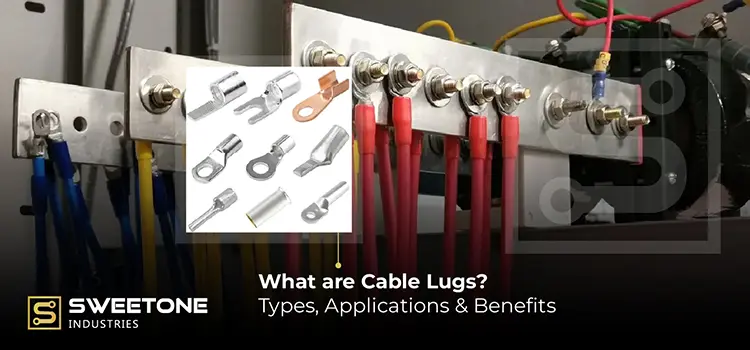
A cable may carry electricity, but it cannot connect safely to a panel, battery, busbar, switch, or machine on its own. It needs a proper metal end that holds the conductor firmly and creates a clean contact point. That metal end is called a cable lug.
In simple terms, a cable lug joins an electrical cable to equipment. Electricians use it where a cable needs a strong, neat, and removable connection. A good lug reduces loose contact, heating, sparking, and damage to cable strands.
This guide explains what cable lugs are, their types, applications, and benefits in clear language. It also covers common mistakes people make while choosing and fitting them.
What Is a Cable Lug?
A cable lug is a metal connector fixed at the end of an electrical cable. The conductor is held on one side of the lug, the other side being attached to a stud, bolt, terminal or busbar;
Most lugs have two parts:
- A barrel where the stripped cable enters
- A flat palm with a hole for the bolt or screw
The installer places the conductor inside the barrel and presses it with a crimping tool. This creates a tight joint between the cable and lug. The palm then connects to the electrical equipment.
Copper, aluminium, and bimetallic materials are commonly used for making electrical cable lugs.
Why Are Cable Lugs Used?
After installation, the tip of a bare cable can spread, bend or become loose. The contact with the terminal can be uneven. This can lead to increased resistance and heat generation.
A cable lug provides the conductor with a fixed shape and a proper contact surface. It also keeps individual wire strands together.
For example, when an electrician connects a battery cable to an inverter, the cable cannot simply sit under the terminal bolt. A ring lug holds the cable firmly and allows the bolt to pass through the lug hole.
That simple connection makes the system easier to inspect, tighten, and replace.
Main Cable Lugs Types
Different cables and terminals need different lug designs. The table below explains the most common cable lugs types.
| Type of Lug | Shape or Material | Common Use |
|---|---|---|
| Ring Lug | Closed round hole | Batteries, panels, earthing points |
| Fork Lug | Open U-shaped end | Screw terminals and control wiring |
| Pin Lug | Thin solid pin | Terminal blocks and small panels |
| Copper Lug | Made for copper cable | Power panels and machinery |
| Aluminium Lug | Made for aluminium cable | Distribution and utility cables |
| Bimetallic Lug | Aluminium barrel, copper palm | Aluminium cable to copper terminal |
| Tubular Lug | Thick round barrel | Heavy-duty power connections |
| Compression Lug | Fitted by crimping | Industrial and commercial wiring |
Ring Type Cable Lugs
Ring lugs have a closed hole at the end. The bolt or stud passes through this hole, which keeps the lug in place.
Commonly used by electricians for battery terminals, circuit breakers, switchboards, generators, inverters and earthing connections.
They work well in places where vibration may occur because the lug cannot slide out easily.
Fork or Spade Lugs
Fork lugs have an open end shaped like the letter U. The installer can slide the lug under a screw without removing the screw fully.
These lugs are useful in control panels, small machines, electrical appliances, and terminal strips. They save time during servicing, but they must be tightened properly.
Pin Type Lugs
Pin lugs turn a flexible stranded wire into a solid pin-like end. This makes it easier to insert the wire into a narrow terminal block.
Electricians use pin lugs in automation panels, meters, relays, contactors, and control circuits.
Copper Cable Lugs
Copper lugs work with copper conductors. Copper carries current well and handles high loads when the connection is fitted correctly.
Many copper lugs come with a tin coating. This coating protects the surface from oxidation and gives the lug a longer working life in damp or industrial areas.
Sweetone Industries offers cable connection products for different wiring needs. Buyers should still check cable size, conductor material, stud size, and load before choosing a product.
Aluminium and Bimetallic Lugs
Aluminium lugs are used with aluminium cables. They weigh less and usually cost less than copper lugs.
However, aluminium forms an oxide layer on its surface. The installer must clean the conductor and use a suitable jointing compound where required.
A bimetallic lug is used when an aluminium cable must connect to a copper terminal. Its aluminium barrel accepts the cable, while the copper palm connects to the equipment. This prevents the two dissimilar metals from being in contact and reduces the risk of corrosion.
Where Are Electrical Cable Lugs Used?
You will find lugs electrical systems use in homes, factories, vehicles, solar plants, commercial buildings, and power projects.
Common applications include:
- Distribution boards
- Switchgear and control panels
- Battery banks and inverters
- Solar power systems
- Transformers and generators
- Electric motors
- Railway systems
- Telecom equipment
In a solar setup, ring lugs may connect battery cables to an inverter. In a factory, heavy-duty compression lugs may join large power cables to a motor control panel.
Benefits of Using the Right Cable Lug
Better Contact
A properly crimped lug keeps the conductor firmly in place. This improves contact and reduces unnecessary resistance.
Less Heating
Loose joints produce heat. The right lug, cable size, and crimping tool help keep the connection stable under load.
Safer Wiring
A lug keeps loose strands away from nearby terminals. This lowers the risk of short circuits, sparking, and accidental contact.
Easier Maintenance
A bolted lug can be removed and fitted again without cutting the cable. This helps during panel repair, battery replacement, or machine servicing.
Longer Cable Life
The lug supports the cable near the termination point. It reduces bending, strand breakage, and damage caused by repeated movement.
How to Choose the Correct Lug
Do not select a lug only because it looks close to the cable size.
Check the following points:
- Match the lug with the cable material.
- Check the cable cross-sectional size.
- Confirm the bolt-hole or stud size.
- Check the expected current load.
- Consider heat, moisture, vibration, and corrosion.
- Use the correct crimping die.
- Choose a lug with proper material thickness and finish.
An oversized barrel will not grip the cable properly. A small barrel may damage the conductor or stop it from entering fully.
Basic Installation Tips
Remove only the required length of insulation. Do not cut or nick the conductor strands.
Insert the cable fully into the barrel. Use the correct crimping tool and die. After crimping pull the cable lightly to check that it does not move.
Fix the lug to the terminal and tighten the bolt to the recommended torque. Use heat-shrink tubing or an insulating cover where the connection may remain exposed.
Conclusion
Cable lugs may look like small parts, but the quality of an electrical connection often depends on them. They hold strands of cable together, improve contact, reduce heating and make repair work easier.
Knowing the different types of electrical lugs will help you select the right product for batteries, control panels, solar systems, machines, transformers, and power distribution work.
Always match the lug with the cable material, cable size, stud hole, current load, and installation conditions. Good material and proper crimping matter just as much as the lug type.
Frequently Asked Questions
1. What is the function of a cable lug ?
A cable lug is a device used to connect an electrical cable to a terminal, panel, busbar, battery or machine.
2. What type of cable lugs are best for a battery?
The battery connection normally uses ring lugs . They fit tight over the terminal bolt .
3. Can copper terminals be used on aluminum conductors?
When connecting an aluminium cable to a copper terminal use a suitable bimetallic lug.
4. How do I know what size lug to buy?
Check the size of the cable, material of the barrel and the size of the terminal hole and diameter.
5. Why is cable lug hot?
A lug can become hot due to loose tightening, bad crimping, corrosion, overload or wrong size lug.