
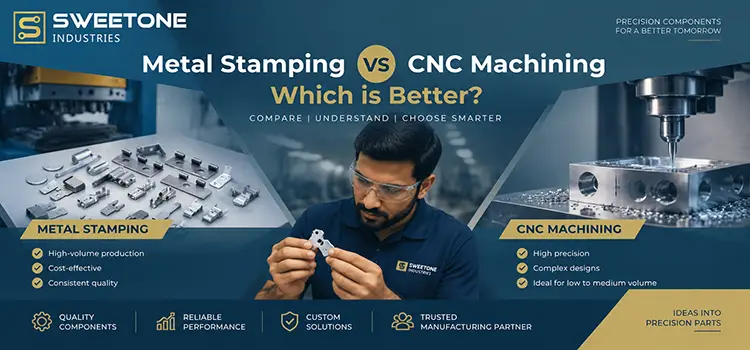
When a metal part needs to be made in large numbers, the production method can have a big effect on cost, speed, and quality. Two common options are metal stamping and CNC machining. Both can make accurate metal parts, but they work in very different ways.
Metal stamping shapes sheet metal with a press and die. CNC machining cuts material away from a solid piece until the required shape is left. One works well for repeat production, while the other is better suited to detailed parts and smaller orders. The right choice depends on part design, quantity, material, and tolerance.
Metal Stamping vs CNC Machining: Which Is Better for Your Production Needs?
If you need thousands of the same part, metal stamping might be more sensible. Once the die is ready the press can make parts quickly and repeatably. That’s why metal stamping is used for terminals, clips, brackets, washers, eyelets and other sheet metal parts.
CNC Machining: is often better suited to low quantity or complex shape parts. A CNC machine is able to drill holes, cut slots, make threads, form pockets, and create detailed surfaces without a dedicated stamping die.
How the Metal Stamping Process Works
The stamping process starts with sheet metal or coil. The material is placed in a press, where a punch and die cut or form it into the required shape.
Common stamping jobs include:
• Blanking
• Piercing
• Bending
• Drawing
• Coining
A simple part may need one operation. A more detailed part may move through several stations. Progressive dies can perform different steps as the strip moves through the press.
This type of stamping manufacturing works well when the same design has to be produced in large numbers. Tooling can cost more at the start, but the cost per piece usually drops as production volume increases.
Where CNC Machining Works Better
CNC machining is useful when a part needs close dimensions or detailed features. It works well for prototypes, custom parts, and short runs because the program can be changed without making a new die.
People sometimes search for CNC stamping, but the methods are different. Stamping forms metal by force. CNC machining removes material with cutting tools.
Cost Difference Between Stamping and CNC Machining
Metal stamping needs a die, and that die must be designed and made before production starts. For a small order, this extra cost may not make sense.
For a large order, the picture changes. Once the die is paid for, each stamped piece can become cheaper because the press works fast and the same tool keeps producing the same part.
CNC machining usually needs less dedicated tooling, but every part takes machine time. This is why metal stamping manufacturers usually ask about expected quantity before suggesting a process.
Accuracy, Tolerance and Part Design
CNC machining is often chosen when close dimensions matter. The machine can control holes, grooves, threads, faces, and other details accurately when the setup is correct.
Stamping can also produce consistent parts.
One thing to watch for is spring back. When the metal has been bent it will try and spring back into shape a little. The die makers know this when they design it.
For Sheet Metal & Precision Components, the drawing should show material grade, thickness, key dimensions, finish, and tolerance.
Material Use and Waste
CNC machining starts with a larger block, bar, or billet and removes material until the final shape is left. Some metal becomes chips or scrap.
Metal stamping can use sheet or coil more efficiently when the strip layout is planned well.
Where Is Metal Stamping Used?
Metal stamping is widely used in electrical, electronics, automotive, appliance, and engineering work.
Common stamped parts include:
• Terminals
• Connectors
• Eyelets
• Clips
• Brackets
• Contacts
• Washers
This section is a natural place to link Eyelets Manufacturer in India , Electronic Components & Assemblies, and Terminals & Connectors.
Which Process Should You Choose?
Choose metal stamping when you need many identical sheet metal parts and the design will stay the same.
Choose CNC machining when the order is smaller, the shape is more complex, or the part needs close machined features.
Sometimes both methods are used. A part may be stamped first and then machined for a hole, thread, or final dimension.
Before ordering, share the drawing, material, thickness, quantity, tolerance and end use with the manufacturer. Sweetone Industries works with eyelets, terminals, connectors, electronic parts, and precision metal components.
FAQs
Is metal stamping cheaper than CNC machining?
It can be cheaper for large orders once tooling cost is spread across many parts.
What parts are made by metal stamping?
Terminals, eyelets, clips, brackets, washers, contacts, and connectors are common examples.
Is CNC machining good for small orders?
Yes. It is often used for prototypes and short production runs.
Can metal stamping make accurate parts?
Yes. Good tooling and proper press setup can produce repeatable parts.
Can stamping and CNC machining be used together?
Yes. A stamped part can be machined later for closer control.