
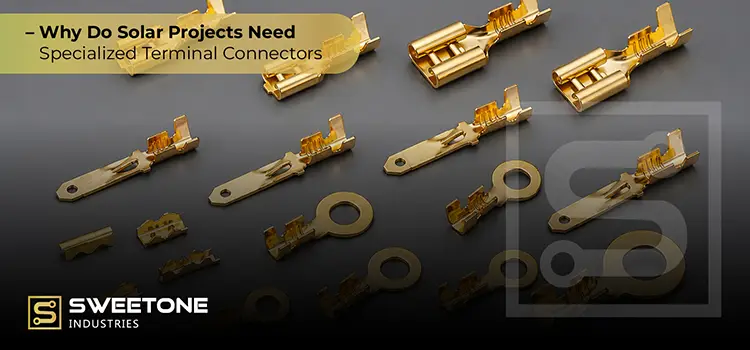
Solar systems work outdoors for years, often under strong heat, rain, dust, humidity, and daily temperature changes. Every connection inside the system has to handle these conditions without becoming loose, corroded, or overheated. That is one reason a normal electrical connection may not always suit a solar installation.
When installers connect modules, junction boxes, inverters, combiner boxes, and cables, they need terminals and connectors made for the job. A suitable solar panel connector keeps the electrical contact firm while protecting the connection from outdoor conditions.
Sweetone Industries manufactures terminals, connectors, eyelets, and precision metal components for electrical and industrial applications. For solar equipment manufacturers , choosing the right connector starts with understanding how the part will actually be used.
Why Do Solar Projects Need Specialized Terminal Connectors for Long-Term Outdoor Performance?
The answer to Why Do Solar Projects Need Specialized Terminal Connectors becomes clear when we look at the working conditions of a solar plant. Solar modules can remain on rooftops or open land for many years. Their wiring faces sunlight, moisture, dust, movement, and wide temperature changes.
A weak connection can increase resistance. More resistance can cause heat build-up, lower electrical output and damage to the connector. Manufacturers consider connector material, contact pressure, cable size, insulation and fitting accuracy for this reason.
Good solar connectors should hold on to the cable tightly and maintain good contact for the life of the system.”
What Does a Solar Panel Connector Do?
A solar panel connector joins cables or electrical parts within a photovoltaic system. Depending on the design, it may connect one panel to another, connect a panel to a junction box, or link the solar array with other electrical equipment.
A good connector does more than join two wires. It should:
- Carry the required current
- Hold the cable securely
- Resist moisture and dust
- Reduce the chance of loose contact
- Handle outdoor temperature changes
- Make installation easier
- Fit the mating connector correctly
For manufacturers of Electronic Components & Assemblies, these small connection points matter because even one poor joint can affect the performance of a larger electrical assembly.
Why Solar Panels Connection Needs the Right Terminal
A proper solar panels connection depends on more than the cable itself. The metal terminal inside the connector must also match the wire size, current requirement, and connector body.
If the terminal is not holding the conductor properly, the wire may loosen after a while. Poor crimp can also add resistance at the contact point.
Solar equipment manufacturers should check the terminal thickness, metal grade, plating, crimp area, and mating size before approving a part for production.
This is where Terminals & Connectors become an important part of solar component manufacturing.
A Good Crimp Makes a Big Difference
Crimping creates the mechanical and electrical bond between the cable and terminal.
If the crimp is too loose, the wire can move. If it is too tight, the strands may get damaged. The terminal therefore needs the correct shape and size for the cable being used.
For bulk production, consistent dimensions are especially important because the same connection may be repeated thousands of times.
Common Types of Solar Connectors
There are several types of solar connectors used across photovoltaic systems. The exact connector depends on the equipment, voltage, cable size, and system design.
MC4-Style Connectors
MC4-style connectors are widely used for module-to-module cable connections. They use male and female parts that lock together.
Their popularity comes from simple installation and suitability for outdoor use when installed correctly.
Junction Box Connectors
Solar panel junction boxes collect current from the cells and provide an output connection for the module cables. The terminals used inside these boxes must maintain good electrical contact.
Inline Cable Connectors
Inline connectors join two cable sections. These are useful when cable routes need extension or when different parts of the solar array need to be connected.
Branch Connectors
Branch connectors allow more than one solar line to come together. They may be used when panels are connected in parallel.
These examples show why understanding different solar panel connector types is important before selecting a terminal design.
What Should Manufacturers Check in Panel Connectors?
Not all panel connectors have the same requirements. Manufacturers should study the final use of the connector rather than selecting a terminal only from a sample.
Important points include:
- Cable cross-section
- Current and voltage rating
- Contact material
- Terminal thickness
- Surface plating
- Crimping method
- Operating temperature
- Required production quantity
The metal used inside the connector can affect conductivity and contact life. Copper and copper alloys are commonly considered for electrical contacts because they provide good current flow.
Solar Panel Connector Types and Material Choice
Different solar panel connector types may require different contact shapes and materials.
Some terminals need strong spring action so the male and female contacts remain tight. Others need good formability because they will be stamped, bent, or crimped during production.
Plating may also be used to protect the contact surface or support stable electrical performance.
Sweetone Industries works with custom terminal and metal component requirements, where buyers can share drawings, dimensions, samples, material details, and production needs.
Why Precision Matters in Solar Connectors
A terminal can be only a few millimetres wide, yet a small dimensional error can stop the connector from fitting correctly.
If the contact is too loose, electrical resistance may rise. If it is too tight, the connector can become difficult to assemble. Poor crimp dimensions can also damage the cable.
Companies that source Sheet Metal & Precision Components often need the same level of dimensional control for terminals, clips, contacts, brackets, and other stamped parts.
Sweetone Industries can support requirements where consistent component size matters across repeated production.
Where Eyelets and Other Metal Parts Fit In
Solar and electrical equipment may use more than connectors alone. Depending on the product, manufacturers may also require eyelets, rivets, clips, stamped contacts, and other small metal parts.
A company looking for an Eyelets Manufacturer in India may also need related electrical components for one product line. The ability to keep these parts in a controlled manufacturing process can also make it easier to match size and repeat orders.
It’s the same with Electronic Components & Assemblies where you have a lot of small parts coming together in one finished product.
Choosing the Right Solar Connectors for Production
The best solar connectors are the ones that match the actual cable, electrical load, mating part, and outdoor conditions.
Manufacturers should provide as much information as possible before placing an order, such as drawings, samples, cable size, current rating, metal requirement, plating and expected quantity.
Early selection of the connector will also help to eliminate last minute changes to crimp tools, cable size or connector housing.
For Sweetone Industries, the emphasis should be on making terminals and precision parts that fit the customer’s required dimensions and application.
FAQs
1. Why do solar panels need special connectors?
Solar connectors need to handle outdoor conditions, electrical load, moisture, heat, and long-term cable connections.
2. What is a solar panel connector used for?
A solar panel connector joins cables, modules, junction boxes, or other parts of a photovoltaic system.
3. What are common types of solar connectors?
Common options include MC4-style, inline, branch, and junction box connectors.
4. Why is crimping important in solar panels connection?
A correct crimp keeps the wire firmly attached to the terminal and helps maintain good electrical contact.
5. Can solar connector terminals be custom-made?
Yes. Terminals can be made according to drawings, dimensions, material, plating, cable size, and production requirements.